History of Artificial Intelligence
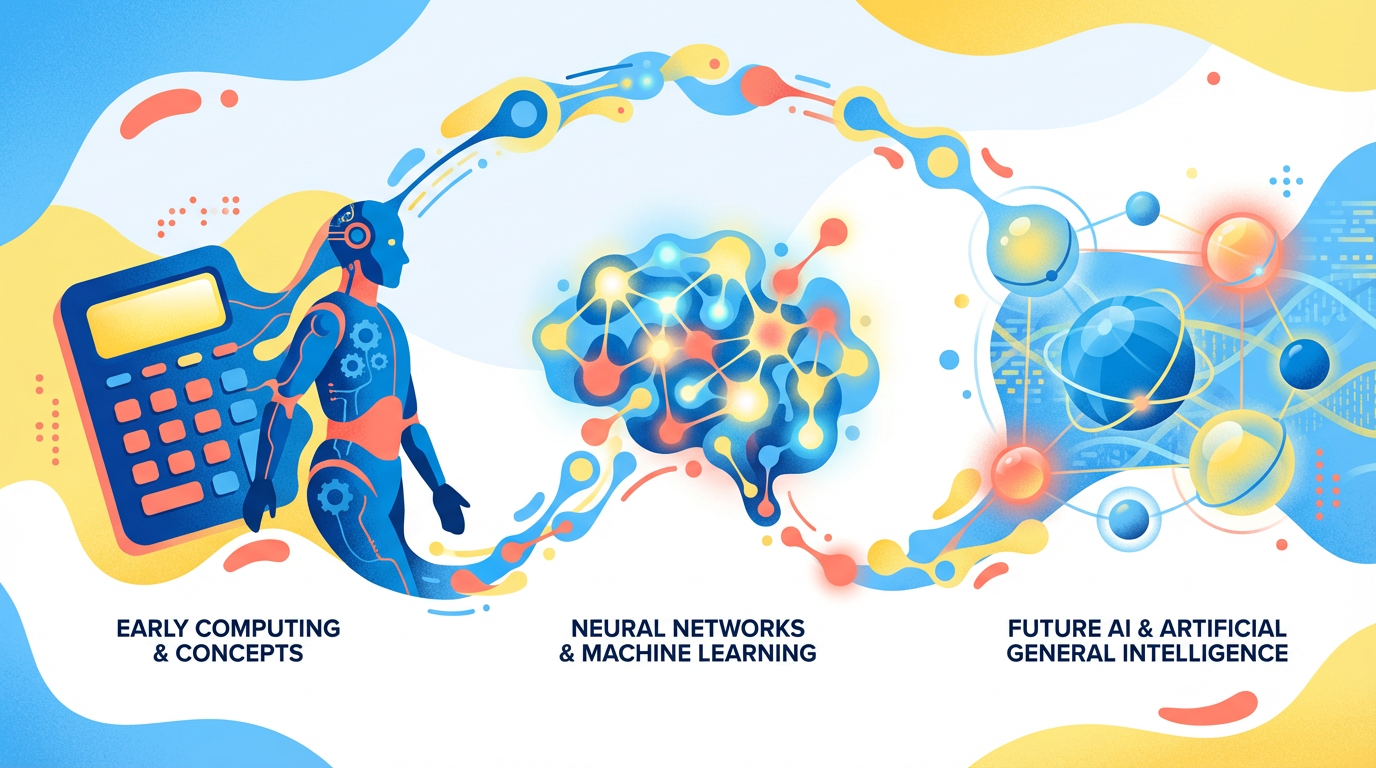
The history of Artificial Intelligence (AI) spans several decades, tracing its roots from ancient philosophical inquiries into the nature of intelligence to modern computational achievements. Early thinkers pondered whether machines could emulate human thought, laying conceptual groundwork that influenced the field's emergence in the mid-20th century. This journey has been marked by periods of rapid advancement, setbacks, and ethical debates, reflecting humanity's evolving relationship with technology.
AI's development accelerated post-World War II with the advent of digital computers, enabling researchers to simulate cognitive processes. Key milestones include the formulation of algorithms, the creation of expert systems, and the rise of machine learning. Understanding AI's history is essential for appreciating its current capabilities and future potential, highlighting both triumphs and challenges.
This chapter provides a chronological overview of AI's evolution, from its philosophical foundations to contemporary breakthroughs. It contextualizes the field's growth within broader scientific, technological, and societal contexts, emphasizing influential figures, pivotal events, and the cyclical nature of innovation and disillusionment.
Section
Philosophical and Mathematical Roots
The conceptual foundations of Artificial Intelligence date back to ancient civilizations, where philosophers speculated on the nature of thought and mechanization. In the 17th century, thinkers like René Descartes explored whether animals could be seen as automata, extending ideas to human cognition. Gottfried Wilhelm Leibniz proposed a universal language and calculus that could mechanize reasoning, foreshadowing computational logic.
The 19th century saw further developments in formal logic and computation. George Boole's algebraic system for logic, published in 1854, provided a mathematical framework for binary operations, essential for digital computing. Ada Lovelace, collaborating with Charles Babbage, envisioned the Analytical Engine as capable of more than mere calculation, hinting at programmable intelligence.
Early 20th-century advances in neuroscience and information theory bridged philosophy with science. Alan Turing's 1936 paper on computable numbers and the Turing machine formalized the concept of mechanical computation, questioning whether machines could exhibit intelligence. This work laid the groundwork for AI by demonstrating that logical processes could be simulated mechanically.
Key Early Milestones
McCulloch-Pitts Neuron Model
Warren McCulloch and Walter Pitts proposed a simplified mathematical model of neural networks, inspired by biological neurons, which became foundational for artificial neural networks.
Hebbian Learning
Donald Hebb's theory of synaptic plasticity suggested that learning occurs through strengthening connections between neurons, influencing early machine learning approaches.
Turing Test Proposal
Alan Turing introduced the idea of a test to determine machine intelligence, positing that a machine could be considered intelligent if it could exhibit human-like conversation indistinguishable from a person.
Logic Theorist
Allen Newell and Herbert A. Simon developed the first AI program to prove mathematical theorems, demonstrating automated reasoning.
Section
Cycles of Hype and Disillusionment
The history of AI is characterized by alternating periods of enthusiasm and stagnation, often termed 'AI winters.' These cycles arise from overpromising technological capabilities followed by unmet expectations, leading to reduced funding and interest. The first AI winter began in the late 1960s after initial optimism failed to deliver on ambitious goals like general intelligence.
Resurgences typically followed breakthroughs in specific subfields, such as expert systems in the 1980s, which simulated human decision-making in narrow domains. However, limitations in scaling these systems led to another winter in the late 1980s. The pattern underscores the challenges of replicating human cognition, from computational constraints to the complexity of real-world problems.
Modern AI has largely overcome these winters through advancements in data availability, computational power, and algorithms like neural networks. Understanding these cycles helps contextualize current AI hype, emphasizing the need for realistic expectations and incremental progress.
AI Winters and Resurgences
Dartmouth Conference
The term 'Artificial Intelligence' was coined at a workshop where researchers like John McCarthy and Marvin Minsky explored AI's potential, marking the field's formal birth.
First AI Winter
Funding dried up due to exaggerated claims and failures in achieving human-level AI, with perceptions of AI as 'toy' problems.
Expert Systems Boom
Commercial success of rule-based systems like MYCIN led to renewed interest and investments in AI applications.
Second AI Winter
Overreliance on brittle expert systems and hardware limitations caused disillusionment, with AI seen as impractical for broader use.
Machine Learning Resurgence
Advances in statistical methods and data collection revived AI, leading to applications in search engines and recommendation systems.
Key Insight
AI winters highlight the tension between theoretical potential and practical implementation, reminding researchers to focus on solvable problems within current technological bounds.
Section
Influential Researchers and Breakthroughs
Key figures in AI have driven its evolution through theoretical insights, algorithmic innovations, and practical applications. Early pioneers like Alan Turing and John von Neumann established computational frameworks, while later researchers focused on learning and perception. Their contributions often intersected with broader fields like mathematics, psychology, and engineering.
Breakthroughs include the development of search algorithms, knowledge representation, and probabilistic models. For instance, the perceptron, invented in the 1950s, laid early groundwork for neural networks, despite initial setbacks. Collaborative efforts at institutions like MIT and Stanford have produced landmark projects, such as SHRDLU, an early natural language understanding system.
These milestones not only advanced AI technically but also sparked ethical and philosophical debates about machine autonomy and human augmentation. Recognizing these figures underscores the interdisciplinary nature of AI development.
Key Figures and Their Contributions
| Figure | Key Contribution | Approximate Year |
|---|---|---|
| Alan Turing | Turing machine and Turing Test, foundational to computational theory | 1930s-1950s |
| John McCarthy | Coined 'Artificial Intelligence' and developed Lisp programming language | 1950s-1960s |
| Marvin Minsky | Pioneered work in neural networks and robotics | 1950s-1980s |
| Geoffrey Hinton | Advanced deep learning and convolutional neural networks | 1980s-2010s |
| Yoshua Bengio and Yann LeCun | Key contributors to deep learning resurgence | 1990s-2020s |
Major Breakthrough Events
ELIZA
Joseph Weizenbaum created the first chatbot, demonstrating natural language processing through pattern matching.
Xerox AI Workstations
Commercialization of AI tools, including expert systems, boosted industry adoption.
Deep Blue
IBM's chess-playing computer defeated world champion Garry Kasparov, showcasing AI in strategic games.
Section
From Deep Learning to Contemporary AI
The modern era of AI, beginning around the 2000s, has been defined by the resurgence of neural networks and the availability of big data. Deep learning, enabled by increased computational power and techniques like backpropagation, has revolutionized fields such as image recognition, speech processing, and natural language understanding. This shift moved AI from rule-based systems to data-driven models.
Advancements in hardware, including GPUs and cloud computing, have facilitated training of large-scale models. Applications now span autonomous vehicles, medical diagnostics, and generative content creation. However, this progress raises concerns about data privacy, algorithmic bias, and job displacement, prompting regulatory discussions.
Current AI research emphasizes general-purpose models, interdisciplinary collaboration, and ethical AI design. Breakthroughs like large language models demonstrate AI's potential to augment human creativity, yet they also highlight the need for robust safeguards against misuse.
Recent Developments
Deep Learning Revival
Geoffrey Hinton and colleagues showed deep neural networks could outperform traditional methods on image tasks.
ImageNet Breakthrough
AlexNet won the ImageNet competition, proving convolutional neural networks' effectiveness in computer vision.
AlphaGo Victory
Google's AI defeated Go champion Lee Sedol, marking a milestone in reinforcement learning.
GPT-3 Release
OpenAI's generative pre-trained transformer demonstrated advanced natural language generation capabilities.
ChatGPT Launch
Public release of conversational AI models spurred widespread adoption and ethical debates.
By the early 2020s, a majority of AI publications focused on deep learning techniques, reflecting its dominance in modern research.